
Oak Tree Pruning: When to Prune and Why Oak Wilt Disease (OWD) Matters
This fascinating disease which primarily affects Red and Black Oaks is surprisingly mysterious in its origin. Scientists have studied this disease for decades since its initial discovery in the 40’s. It is suspected that it could have originated in South or Central America, and possibly even Mexico. Interestingly enough, the first documented and officially named case of OWD was in Wisconsin in 1942. Pathologist J.H. Bretz made the discovery after observing unusual Oak tree mortalities.
As Arborists, we often get asked about Oak pruning and will hear things such as; “I heard you’re only supposed to prune Oaks in the winter” or “Is it too late to prune my Oak trees this year?”. While those are all valid concerns, Oak tree pruning guidelines are generally very simple to follow. We prune Oak trees between the months of October and April. The “WHY” of the matter is a bit more complicated, but can be boiled down to a couple key points. Let’s discuss
Cooler weather keeps sap-feeding beetles mostly dormant, lowering the chances of overland transmission of OWD.
Pruning Oak trees in a dormant state allows the tree to rebound better in the spring. Photosynthesis isn’t disrupted because there are no leaves present, allowing the tree to retain stored energy and use it to apply new growth in the spring.

Agencies like the USDA and the DNR make recommendations on an annual basis regarding the safe pruning season for Oaks here in Michigan. Your trusted local Arborists are also going to be a valuable resource, as some areas of the state are going to be more prone to OWD spread.
It’s key to understand HOW this fungal disease spreads and disrupts large populations of Oak trees, so that we can better manage the wooded areas in our communities. There are two forms of transportation for this disease:
Overland; via beetles that carry the fungal spores from one tree to another, landing on a fresh pruning cut or a limb-tear. Less than 10% of all cases are spread this way.
Root-grafting; interconnected systems of roots underground when Oak trees grow in closely. This is most common in Red Oaks and least common in White Oaks and Burr Oaks.
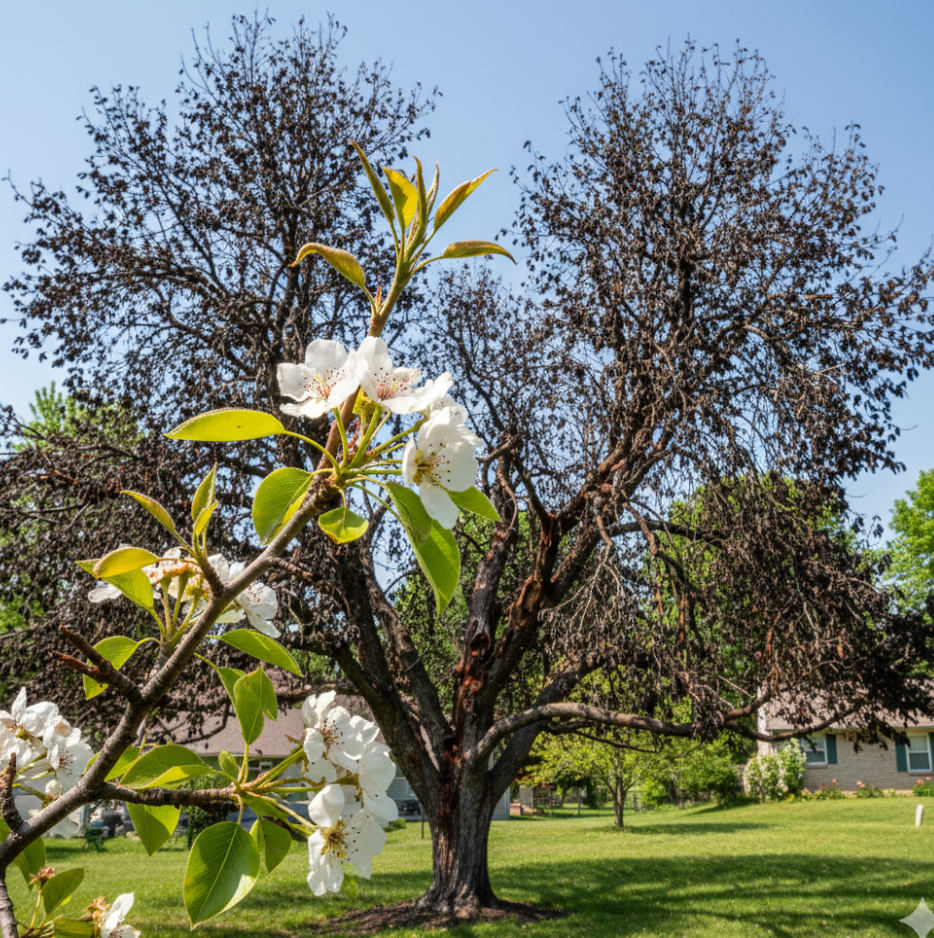
Once a tree is affected, it can take just weeks for the disease to disrupt water flow causing leaves to wilt, vessels to become plugged, and the fibers of the wood to essentially suffer a severe internal drought. In a rural wooded setting, this disease spreads in pockets of Oak trees that are un-maintained and may cause large amounts of Oaks to die. In a more urban setting, it may only be one tree in a large neighborhood that shows symptoms of OWD. For this reason, it is much easier to mitigate the spread of the disease in our cities and villages.

SO, WHAT CAN WE DO TO CONTROL OAK WILT DISEASE?
Our first line of defense as Michiganders starting to see the onset of OWD in the lower peninsula is to simply schedule your pruning to occur between late October and early April. Do not transport firewood (especially Oak) across county lines, especially in the warmer months. Keeping your Oak trees managed means speaking with your trusted Arborist at K&H Tree Service to develop a plan that makes sense for those trees unique to your property. We recommend assessing and/or pruning in 3–5 year cycles for most residential trees, including Oaks. Removing dead limbs, pruning overgrowth and managing tree size and proximity to structures are all great ways to prevent limb or tree failure and keep your Oaks in the best condition to defend themselves against outside stressors.

WHAT IF MY OAK(S) ALREADY HAVE OAK WILT DISEASE?
For Oak trees that are actively wilting, treatment is possible but not always practical. A plan of action first begins with early detection. Can we see visible deterioration of the foliage that is widespread throughout the canopy of the tree? If so, consult with your trusted Arborist as soon as possible. It will be necessary to determine if the affected tree(s) are desirable trees, and what the inherent value is to the owner. Treatment of the affected tree will include a fungicidal injection if the symptoms are discovered early enough. To prevent the disease from spreading to nearby trees, mechanical trenching to a depth of 5 feet is often recommended. This trenching needs to be carefully laid out, as it is the single most effective method of prevention. Trenching can be difficult, and nearby trees, utilities, and structures all need to be carefully accounted for. This disrupts the root systems that are often grafted together from tree to tree and stops the fungus from spreading further. Trenching is usually done when there is already a confirmed case of OWD from a recently wilted tree, which is adjacent to one or many Oak trees which are otherwise healthy.
Contact us today for a free estimate and experience the difference a true professional tree service makes. 📲 269-491-8644 🌐 khtreeservice.com Serving the greater Kalamazoo area, including Mattawan, Paw Paw, Lawton, Portage, Schoolcraft, Vicksburg, Galesburg, Scotts, Plainwell, Oshtemo, Alamo, Cooper, Gobles, Bangor


Comments