
Fire Blight in Bradford Pear Trees: What Southwest Michigan Homeowners Should Know
Bradford pears (Pyrus calleryana ‘Bradford’) were once planted widely across Kalamazoo, Portage, and other Southwest Michigan neighborhoods for their fast growth and heavy spring blooms. While attractive in their early years, these trees come with well-documented structural weaknesses and a high susceptibility to fire blight—a destructive bacterial disease that can rapidly kill branches and, in severe cases, entire trees.
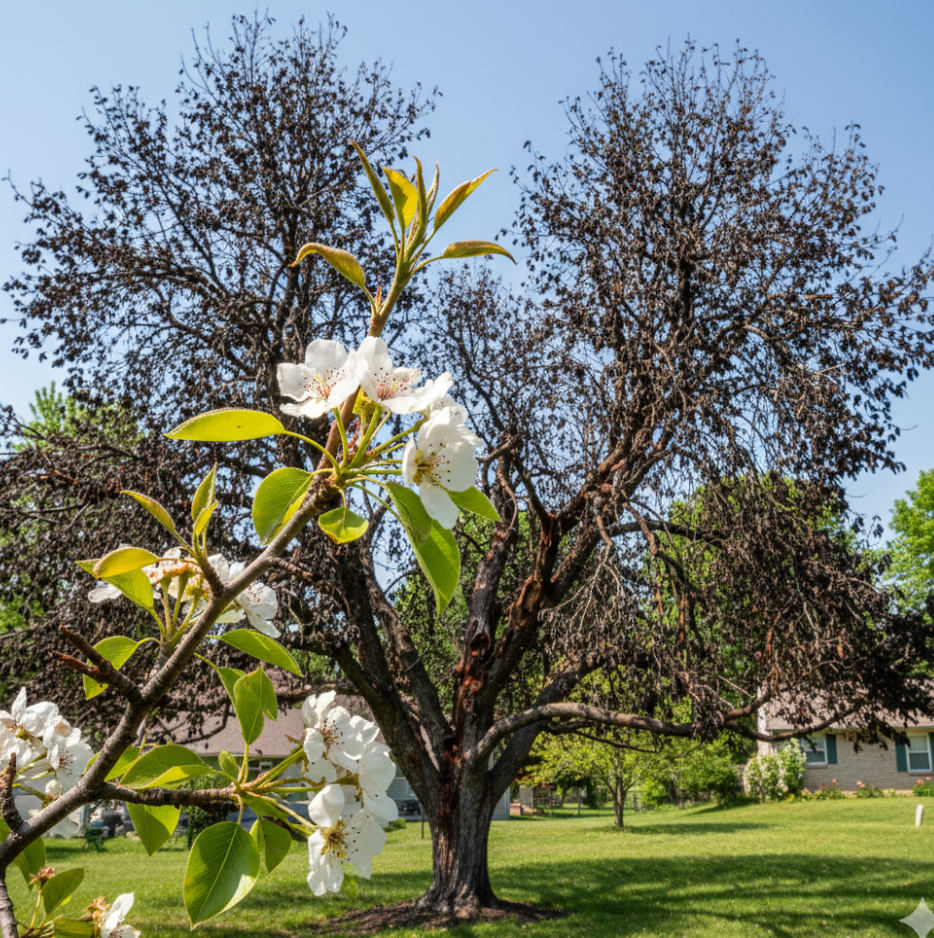
Fire blight is caused by Erwinia amylovora, a bacterium that thrives during warm, humid spring weather—conditions Southwest Michigan experiences regularly. That’s why homeowners here often notice symptoms shortly after bloom: sudden blackening of new shoots, wilted leaves that cling to the branch, and the characteristic “shepherd’s crook” bend at the shoot tip. These symptoms make the tree appear scorched or burned, which is how the disease earned its name.
Why Bradford Pear Trees Are Especially Vulnerable
One of the reasons Bradford pears decline so quickly from fire blight lies in their branch structure. These trees develop extremely tight, upright branch unions with narrow crotch angles. As the tree matures, these weak unions create internal pressure and bark inclusions that make branches prone to splitting—even in moderate wind events.
When fire blight enters through blossoms or wounds, it easily travels through these structurally compromised branch unions. Cankers form along the limbs and trunk, and because the tree’s architecture is already under stress, affected sections fail more rapidly than they would on stronger, better-structured species. This combination of poor branch arrangement and disease susceptibility is why Bradford pears often decline sharply once infected.
How Fire Blight Spreads in Southwest Michigan
Warm, wet spring weather—common in West Michigan—creates ideal conditions for infection. The bacteria spread through:
Rain splash
Insects visiting blossoms
Contaminated pruning tools
Wind-driven contact between infected and healthy shoots
Because ornamental pears are so common in local landscapes, one infected tree can serve as a reservoir for surrounding properties.

Management and Treatment Options
Fire blight cannot be “cured,” but it can be managed if caught early.
Pruning:Remove infected shoots 8–12 inches below the visible canker. Prune only during dry weather and sterilize tools between each cut to prevent bacterial spread.
Chemical Assistance:Dormant-season copper sprays can help reduce surface bacteria. During bloom, targeted antibiotic applications—typically done by licensed professionals—may protect blossoms in high-risk seasons. Because repeated antibiotic use can lead to resistance, treatments must be applied responsibly and only when warranted.
When Removal Becomes Necessary
A Bradford pear may require removal if:
More than half the canopy shows fire blight symptoms
Cankers are present on the main trunk or major scaffold branches
Structural integrity is compromised (common with Bradford pears)
The tree threatens nearby fruit trees or ornamental pears
In many cases, removing a declining Bradford pear and replacing it with a more resilient species is the safest long-term solution.

Southwest Michigan Homeowners: What To Do Next
If your pear tree has suddenly turned black or wilted this spring, fire blight may be the cause. Early intervention makes a significant difference, and improperly timed pruning can worsen the disease—so professional evaluation is strongly recommended.
Contact us today for a free estimate and experience the difference a true professional tree service makes. 📲 269-491-8644 🌐 khtreeservice.com Serving the greater Kalamazoo area, including Mattawan, Paw Paw, Lawton, Portage, Schoolcraft, Vicksburg, Galesburg, Scotts, Plainwell, Oshtemo, Alamo, Cooper, Gobles, Bangor, and nearby communities.


Comments